How to Turn Job Duties Into Resume Accomplishments: 10 Examples
How to turn job duties into accomplishments resume: use task, action and proof. Get 10 examples with placeholders and a no-metrics method.
By Ultimate Resume Kit by Cosmo Suite · Editorial policy
Published · 10 min read
Turning job duties into accomplishments means showing what you did and what you delivered. A duty names the work. A stronger resume bullet adds your action, enough context to understand it, and a result or deliverable. You do not need a dramatic achievement or a percentage for every line.
The U.S. Department of Labor's 2026 Resume Essentials guide recommends targeted achievement statements and describes STAR: situation, task, action and result. This article turns that advice into a three-question check, then gives ten placeholder examples. Replace each bracket with a fact you can support, and remove details you cannot verify. See the Department of Labor guide for its full STAR discussion.
Key takeaways:
- Start with a real responsibility, not a stronger-sounding claim.
- Add the action you took and the context that makes the work clear.
- Include a result, output or number only when you can explain where it came from.
- If there is no reliable metric, write a specific bullet without one.
Duty vs accomplishment at a glance
A duty statement names a recurring responsibility, such as answering customer questions. An accomplishment statement connects your own action to a result, deliverable or clear scope. It does not need a dramatic outcome. The goal is to give a reader enough detail to understand the work and see what you contributed.
An accomplishment bullet is a resume line that connects your action to a result, deliverable or clear scope. It adds detail to the duty while keeping your claim accurate. The wording should still sound like your work and fit the role you want.
| Job duty | What is missing | A clearer bullet can add |
|---|---|---|
| Answered customer questions | What kind of questions and how you handled them | Answered [type] questions by [action], helping customers [verified outcome] |
| Prepared weekly reports | What information you used and who relied on it | Compiled [data] into a weekly report used by [audience] to [verified purpose] |
| Scheduled appointments | Scope, tools or service context | Coordinated [type] appointments across [verified scope], resolving [specific issue] |
The examples in the table are patterns for your own details. Fill each bracket from your experience. If you cannot verify a measured change, end with a concrete deliverable. Remove any placeholder that does not fit your task or level of responsibility.
For the document itself, start with a readable structure and standard headings. Our guide to an ATS-friendly resume format covers the layout choices that help keep sections clear when a file is uploaded. Check that the same wording stays easy to scan on screen and on paper.
Use three questions to turn a duty into a bullet
An accomplishment bullet is a concise resume line that shows an action and what followed from it. To draft one, identify the task, name what you did, then add a result or output you can support. This three-question method keeps the wording specific without turning a routine responsibility into an inflated claim.
Ask what the task was, what you did, and what proof shows the result or output. This keeps the bullet tied to your contribution instead of swapping a plain verb for a grander one. Write the first version in ordinary language before trimming it for space.
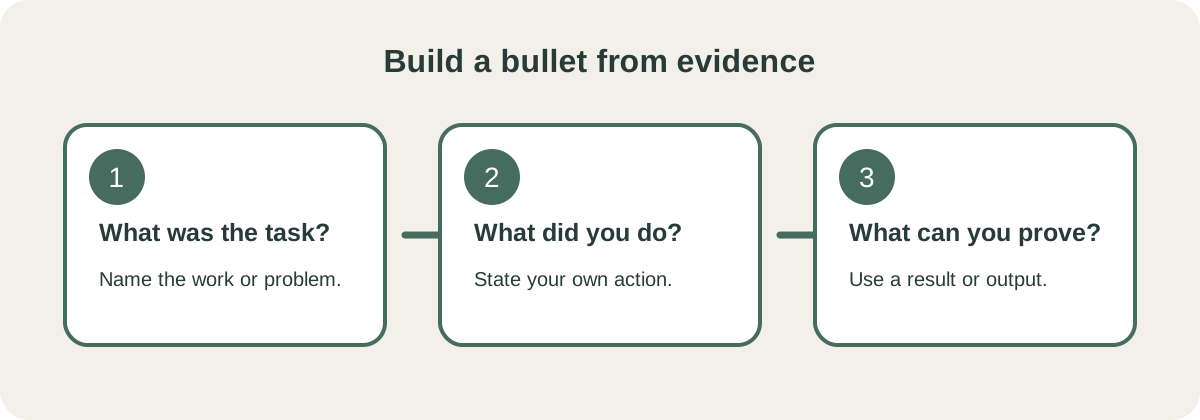
1. What was the task or situation? Name the work in specific terms. “Handled customer issues” could mean refunds, order changes, account questions or product troubleshooting. Choose the part that matches the job you want.
2. What did you do? State your own action. Did you organize, explain, review, repair, coordinate, train or create something? If you worked with a group, make your part clear. “Contributed to a launch” is vague; “prepared the staff checklist for launch day” tells the reader what you owned.
3. What changed, or what did you deliver? Use a result you can explain. It might be a documented improvement, a completed deliverable, a resolved issue, a service provided, a deadline met, or a process someone could use. If you have a reliable measure, add it with its unit and time period. If not, stop at the accurate output.
Yale's Office of Career Strategy presents accomplishment bullets as action, project and result. The Department of Labor guide uses situation, task, action and result. Both connect an action to evidence. Draft with three questions, then keep only the details a hiring reader needs.
Find proof before adding numbers
An impact metric is a number that describes a measured result, such as a change in time, volume or error rate. Use one only when you can identify what was measured, the period and a reliable source. If those pieces are missing, describe a verifiable output or scope instead of guessing at a percentage.
Check your records before you quantify a result. CareerOneStop recommends adding context and asking what happened because of the work. It suggests numbers when they are available. A guessed metric weakens a specific example.
Review records you can access and discuss: plans, reviews, schedules, service logs, reports, quality checks, invoices or handoff messages. Use only information you may share. Keep confidential customer, patient and company details off a public resume. When a record is unclear, ask its owner what the field measures before relying on it.
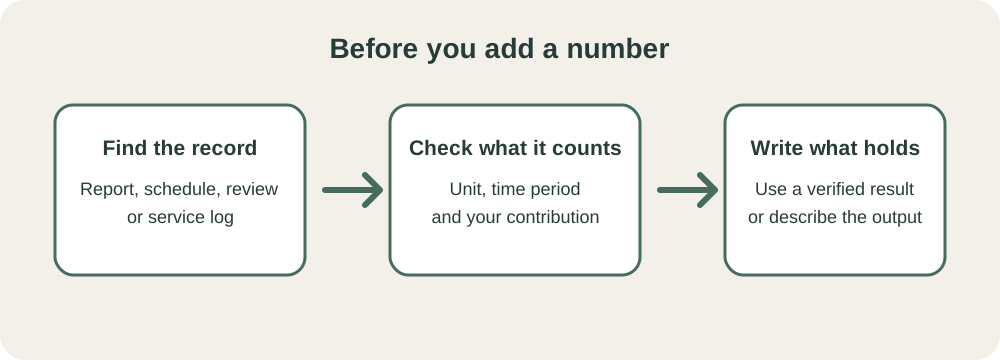
When you find a number, record what it counts and the period it covers. The pattern “Reduced wait time by [X]%” is a placeholder, not a result. It needs a baseline, a later measurement and a clear link to your action. If you cannot explain those pieces, remove the metric. A count of completed items may be easier to verify.
Before writing, fill in a quick note for each example you might use:
| Note | Your check |
|---|---|
| Task | What were you asked to do? |
| Action | Which part did you handle yourself? |
| Evidence | Which record or work sample supports the detail? |
| Result or output | What changed, finished, or reached someone? |
Keep the note with the source you checked. It does not need to go on the resume. The point is to make it easy to confirm the wording later, especially when you tailor the same experience to different roles. Save enough context to find the record again.
No metric? Describe verified scope or output instead: cases handled, schedules coordinated, documents produced, standards followed or audiences served. Avoid filler such as “successfully” when you cannot name what success looked like.
Ten job-duty examples rewritten as accomplishment bullets
These ten patterns show how to add an action, context and a supportable result or deliverable to common duties. They are templates, not claims about real workers. Replace bracketed text with details from your experience, and remove any clause you cannot support. The examples below use placeholders where a fact must come from you.
| Role | Duty | Accomplishment pattern |
|---|---|---|
| Customer service | Answered customer questions | Resolved [issue type] by [action], documenting [verified outcome or handoff] for [audience]. |
| Administrative support | Managed calendars | Coordinated [meeting type] for [verified group], preparing [materials] and resolving [documented conflict]. |
| Retail | Restocked shelves | Reorganized [stock category] using [method], making [item or process] easier for [audience] to locate. |
Each row is a before-and-after pattern with placeholders only. Check that the action was yours and that the ending describes a real deliverable, scope or measured result. A useful bullet can stop after the deliverable; it does not need an invented business impact to sound specific.
Each “before” line below is a generic duty. Each “after” line is a fill-in structure, not a claim about a real person's results. Replace the bracketed text with details you can verify. Delete any clause that does not fit your experience.
Customer service
Duty: Answered customer questions.
Accomplishment pattern: Resolved [type of issue] by [action], documenting [specific outcome or handoff] for [team or customer group].
Administrative support
Duty: Managed calendars.
Accomplishment pattern: Coordinated [type] meetings for [verified number or team], resolving schedule conflicts and preparing [agenda or materials] before each session.
Retail
Duty: Restocked shelves.
Accomplishment pattern: Reorganized [category] stock using [system or method], making [specific item or process] easier for [staff or customers] to locate.
Teaching or tutoring
Duty: Helped students with assignments.
Accomplishment pattern: Explained [subject or skill] through [method] for [class, group or individual], then tracked [completed work or learning check].
Operations
Duty: Processed orders.
Accomplishment pattern: Reviewed [order type] against [documented checklist], correcting [verified issue type] before [handoff or next step].
Project coordination
Duty: Supported a project team.
Accomplishment pattern: Maintained [schedule, issue log or status report] for [project], flagging [specific dependency] so the owner could act before [milestone].
Food service
Duty: Prepared orders during busy shifts.
Accomplishment pattern: Prepared [menu or order type] while following [safety or service standard], coordinating with [team role] during [verified shift context].
Sales support
Duty: Followed up with leads.
Accomplishment pattern: Recorded [next step] after [type of interaction] in [system], giving [salesperson or team] a clear handoff on [customer need].
Healthcare administration
Duty: Scheduled patient visits.
Accomplishment pattern: Coordinated [visit type] across [verified schedule scope], confirming [required information] and routing [specific exception] to [appropriate role].
Volunteer work
Duty: Helped organize an event.
Accomplishment pattern: Coordinated [specific part] of [event or program], preparing [materials, sign-up list or schedule] for [verified audience].
These examples use context and deliverables. Claims such as “increased satisfaction” or “saved time” need evidence. If records support a result, specify the baseline, result and period. Keep the source of each figure in your notes so you can answer follow-up questions.
Tailor the bullet to the job posting
Tailoring means choosing a true example that matches a skill or task in the target posting. Use the employer's terms only when they accurately describe your experience. Then select the strongest evidence you have, such as a completed deliverable, documented result, verified scope or quality standard. This keeps the wording relevant and truthful.
Yale recommends connecting an action and project to a result. CareerOneStop advises using relevant terms from the job posting. Compare your draft with the actual posting, then remove terms that overstate your experience.
Make a short list of the posting's recurring tasks and skills. Match each to one real example from paid work, volunteering, coursework or a project. Then decide which evidence is strongest: a result, a finished deliverable, a measure of scope, or a quality standard. You do not need to force every experience into the same bullet formula.
Check who performed each action. If a team reduced processing time, describe your part: “Reviewed intake steps and documented the new handoff.” Claim the reduction only when evidence supports your contribution. Keep shared achievements accurate and give credit for other people's work.
For example, if a posting asks for inventory tracking, a retail candidate might describe a real stock organization task. A project assistant might mention maintaining a supply log. The work does not become the same experience just because both examples connect to the skill. Keep the source, action and scope truthful.
If your experience includes a career break, choose relevant examples without changing dates or implying work you did not do. This resume guide to employment gaps covers an accurate timeline and ways to describe the break if you choose to address it.
When the result is hard to measure
When a result has no reliable measurement, use a concrete output, verified scope, quality check or handoff. These details can show what your work involved without claiming an unproven improvement. Choose the ending that best fits the evidence you have, and leave out any number or outcome you cannot explain.
Use an accurate deliverable or scope when there is no defensible metric. A result does not have to be a revenue increase; completing a report, resolving a documented issue or coordinating a handoff can show useful work. Name the finished work plainly and let the reader judge its relevance.
Try one of these endings:
- Output: prepared [document, schedule or resource] for [audience].
- Scope: supported [verified number or type of cases] during [period].
- Quality: checked [work] against [named standard or checklist].
- Handoff: routed [type of issue] to [appropriate role] with [needed information].
Use “led,” “owned” or “managed” only when those verbs describe your role. If a team produced the outcome, say what you personally contributed. If you cannot remember the details, write them down from reliable records or leave that example out.
Why trust this article
We checked public career guidance from the U.S. Department of Labor, CareerOneStop and Yale's Office of Career Strategy on 24 October 2026. These sources support action-focused examples, context and results when evidence is available. They do not verify the examples as anyone's personal achievements.
Replace each placeholder with a fact you can explain. Follow the application's instructions and check every number against your records. The site's editorial policy explains how product details are handled. The contact page lists how to reach the publisher.
Where Ultimate Resume Kit fits
The writing guide in Ultimate Resume Kit includes a section on what to write, including duties into achievements and tailoring. The kit also contains one-page and two-page resume templates, a matching cover letter, a references page and a PDF writing guide. The templates are available for Word, Google Docs and Pages, in US Letter and A4 sizes.
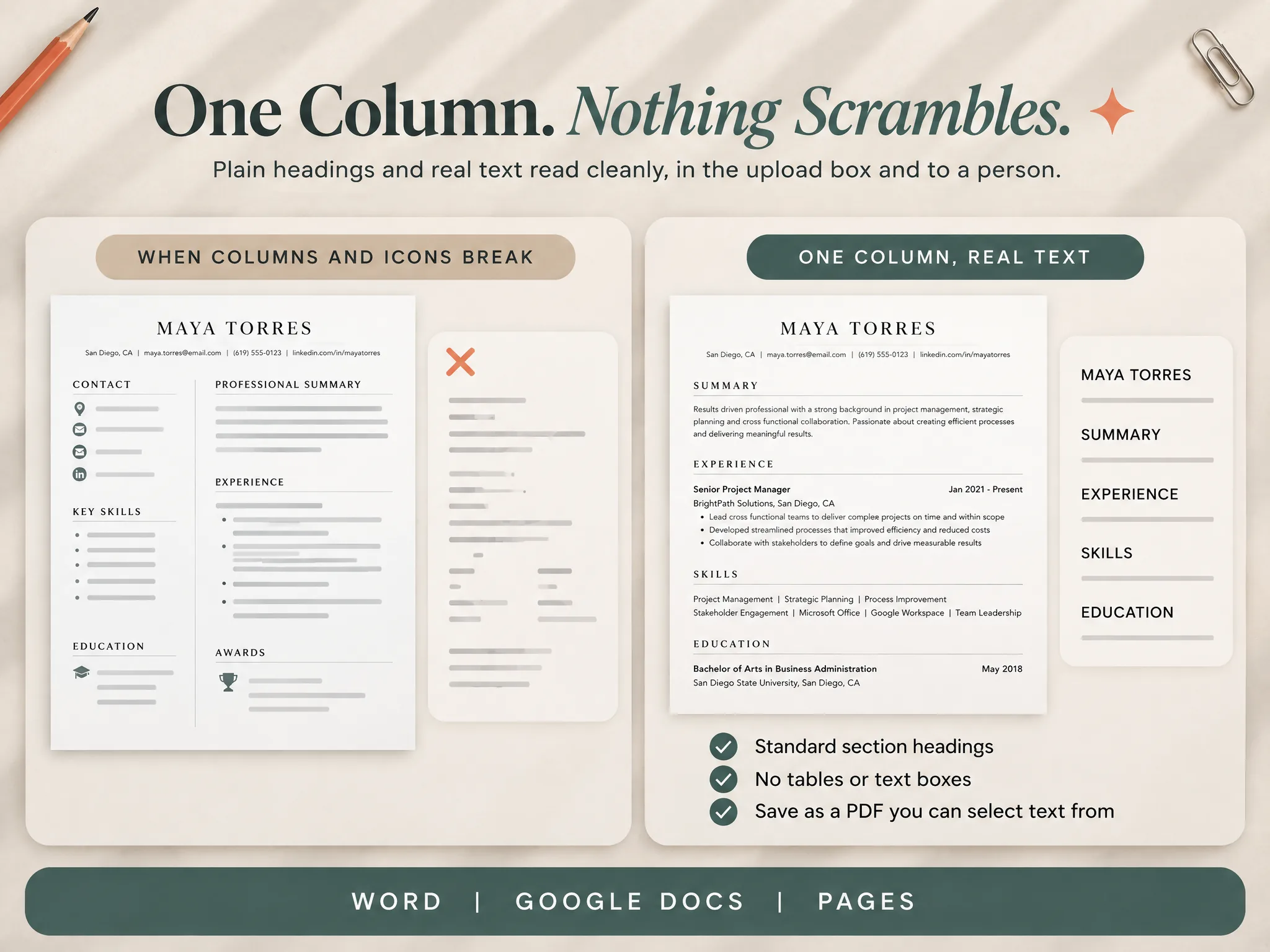
The kit provides a format and writing prompts. You supply the details, check each date and number, and decide which examples fit the role. The resume templates and writing guide may help if you want those pieces in one matching set.
Frequently asked questions
How do you describe job duties on a resume?
Name the action you took, add enough context to show the work, then include a result or output you can verify. For example, replace 'responsible for weekly reports' with a specific description of what you prepared and who used it. Do not add a result or number unless your records support it.
How can I turn responsibilities into achievements?
Start with one responsibility. Ask what you did, what problem or goal it served, and what changed or was delivered. Use the strongest true detail you can support, such as a completed project, a service provided, or a measured result.
What if I do not have numbers for my resume accomplishments?
You can write a useful bullet without a metric. Describe the scope, frequency, audience, output, or quality standard if you can verify it. A clear action and concrete deliverable are better than an estimated percentage you cannot explain.
Should every resume bullet have a number?
No. Use a number when it is accurate and helps explain the work. If you cannot verify one, describe the action, context, and result in plain language. Do not guess a percentage or claim a team outcome as your own.
How many accomplishment bullets should I write for each job?
Choose the bullets that best support the role you want and fit the space available. CareerOneStop suggests about five to eight bullets for each job as a guide, while also saying to focus on important tasks and accomplishments rather than listing everything.
Can volunteer work count as a resume accomplishment?
Yes, when the work is relevant to the role. Describe what you did and the real output or result, just as you would for paid work. Label the experience accurately as volunteer work, a project, coursework, or employment.
How do I tailor an accomplishment bullet to a job posting?
Choose a real example that shows a skill the posting asks for. Use the employer's accurate terms for that skill, then make your own action and result clear. Do not copy requirements as if you have experience you do not have.