How to Explain an Employment Gap on Your Resume
How to explain an employment gap on a resume: show accurate dates, add a short label if it helps, and prepare an interview answer. Copy examples by reason.
By Ultimate Resume Kit by Cosmo Suite · Editorial policy
Published · 8 min read
To explain an employment gap on your resume, start with the actual dates. Then decide whether a short label will help the reader follow the timeline. You can describe a break for caregiving, health, a layoff or study without turning your resume into a personal statement.
CareerOneStop's resume guide says a resume does not need to explain the reason for a gap. It recommends truthful employment dates and notes that a cover letter or interview can be a better place for context. The University of Texas at Austin career center's resume-gap guide gives another option: a short entry with a title, dates and relevant details. The choice depends on your privacy, the length of the gap and the job.
The examples below give you a place to start. Change each one to fit your history, choose what personal details to share, and prepare a brief answer in case an interviewer asks.
Key takeaways:
- Keep job dates accurate, including the month when a form asks for it.
- A gap does not always need its own resume entry.
- If you label a longer break, use a neutral title and one factual line.
- Give more context in a cover letter or interview only when it helps explain your timeline.
What to write for a two-year employment gap
Start with the dates you can verify. If your last job ended in March 2022 and you are applying again in March 2024, show those dates as they happened. Do not shift a job's end date or stretch another role to make the gap less visible.
Next, choose one of three formats:
| Option | Example | Use it when |
|---|---|---|
| Leave it unlabeled | List each job with its actual dates | The timeline is clear and the gap does not need a resume entry |
| Add a short career-break entry | Career Break for Family Caregiving · Apr 2022–Mar 2024 | A longer gap would otherwise look confusing, and you want to give a brief context |
| Explain it outside the resume | One sentence in a cover letter or interview | You want the resume focused on experience or prefer to discuss context later |
CareerOneStop says an explanation is optional and suggests that a cover letter or interview may be a better place for it. The UT Austin career center says applicants can also include a gap entry with a title, dates and bullets. Pick the one that feels accurate and gives the reader enough context.
For gaps under a year, CareerOneStop says you may choose to show only years for previous jobs. It also warns that some applicant tracking systems look for months or even days. Because the plan here is a two-year break, month-and-year dates are usually the clearest way to show the timeline. Follow any date format an application requires.
How to label a career break without oversharing
If you decide to add an entry, keep the title short and the detail factual. You are describing a period in your work history, not making a case that the reason was worthy. Avoid labels that sound apologetic, such as “unfortunately unemployed,” or vague phrases that suggest a job title you did not hold. The UT Austin guide's examples use a plain label, dates and details that match the activity.
Use a version that fits your actual reason:
- Caregiving:
Career Break for Family Caregiving | Apr 2022–Mar 2024 - Health:
Career Break | Apr 2022–Mar 2024orCareer Break for Health Reasons | Apr 2022–Mar 2024 - Layoff:
Role ended in company restructuring | Apr 2022 - Study:
Full-time Study | Apr 2022–Mar 2024followed by the real course, program or credential, if relevant
These are examples of wording, not claims to copy without checking. Replace the dates and details with your own. If you took a break for health reasons, you can keep the resume entry general. You do not need to name a diagnosis or treatment. If the employer later needs information for an accommodation process, handle it through that process.
Only add bullets for activities you actually completed. A course, volunteer role, freelance project or certification can be listed if it is real and relevant. Do not invent professional development to fill empty space. If there is nothing relevant to list, a short title and date range are enough.
Copyable lines for common reasons
Use the lines below as a starting point for a cover letter or an interview. The brackets mark details to replace. Keep the explanation to one or two sentences, then return to your qualifications or interest in the job.
Caregiving
I took time away from paid work to care for a family member. I am now ready to return and am interested in this role because [specific reason tied to the work].
Health
I took a career break for health reasons. I am ready to return to work and would like to discuss how my experience in [relevant area] fits this position.
Layoff or restructuring
My position ended during a company restructuring in [month, year]. Since then, I have been looking for a role where I can use my experience in [relevant skill or field].
Study or a credential
I stepped away from work to complete [course or program]. I am now looking for a role in [field] where I can apply [relevant learning or experience].
A gap after leaving a job
I left my previous role in [month, year] and took time to [brief truthful reason, if you want to share it]. I am now focused on [type of role or work].
Keep each sentence true. If the reason is private, use a more general phrase. If you mention a course, credential or project, be ready to say what it involved. A short explanation is usually easier to deliver than a long defense of the time away.
How much detail should you share?
Share enough for the reader to understand the timeline, then stop. Your resume can say “Career Break” without describing a family member's condition or the details of your own health. In an interview, you can use a general explanation and move toward what you are prepared to do next.
Harvard Business Review advises candidates to prepare to explain job transitions during an interview. That preparation does not require a full personal history. Write a one-sentence version, say it aloud, and check whether it answers the question without exposing details you would rather keep private.
For example, “I stepped away from work to care for a parent, and I am ready to return to project coordination” gives a reason and a direction. You can make the last part specific to the role. For health, “I took a career break for health reasons and am ready to return” may be enough. You do not need to describe a diagnosis.
If you are unsure what a job application asks, read the field labels carefully. An employment history section may request dates, while a separate question may ask about a reason for leaving. Answer the question that appears on the form, truthfully and briefly. A resume and an application form may ask for different levels of detail.
Explain the gap in a cover letter or interview
Use a cover letter only if the context helps the employer understand your timeline or your current fit. Keep the explanation short, then point to relevant experience. You can use this structure:
- State the gap in plain language.
- Give the reason at the level of detail you are comfortable sharing.
- Connect the next sentence to the job or your relevant experience.
Example: “After my role ended in a restructuring, I took time to care for a family member. I am now applying for operations roles where I can use my experience coordinating schedules and vendor work.”
This is a fictional wording example. Replace the reason and skills with your own facts. If the gap does not affect your fit and the application does not ask about it, you can leave it out of the cover letter. For more on keeping the rest of the document easy to scan, see this guide to an ATS-friendly resume format.
Prepare for the follow-up question
An interviewer may ask what happened during the break or whether you are ready to return. Prepare an answer that does three things: answers the question, sets a boundary if you want one, and returns to the role.
Try this outline:
I took time away because [brief reason]. I prefer to keep the personal details private. I am ready to return, and this role interests me because [specific connection to the work].
You can remove the privacy sentence if it does not fit your situation. You can also be more specific if you want to. The point is to choose your answer before the conversation, rather than decide under pressure.
If you were laid off, say so plainly. Avoid apologizing for a decision the employer made or guessing what the interviewer thinks. If you left a role for health or family reasons, you can keep those details broad. If you completed a course or project, mention it only when it supports the job you want.
Where Ultimate Resume Kit fits
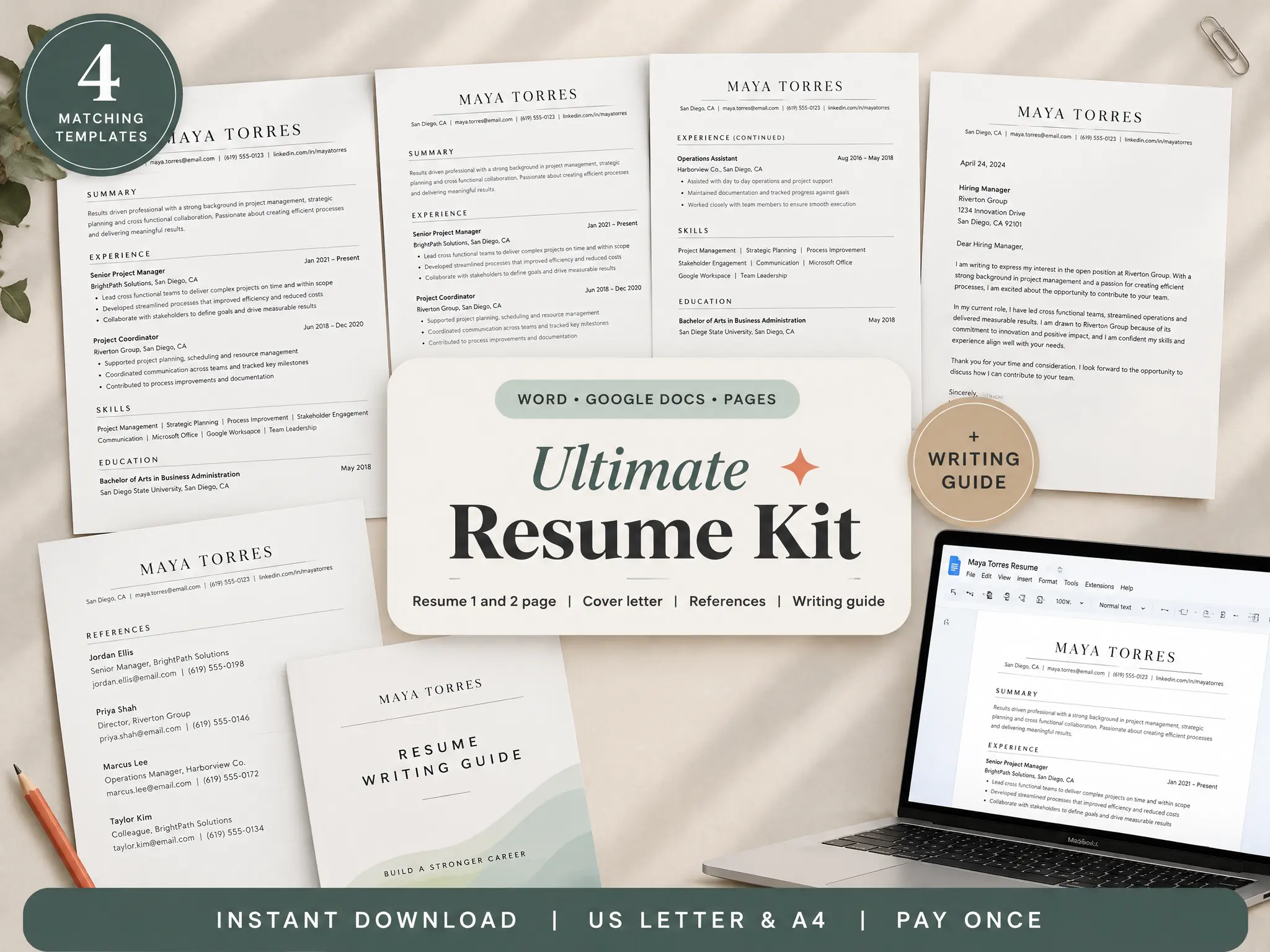
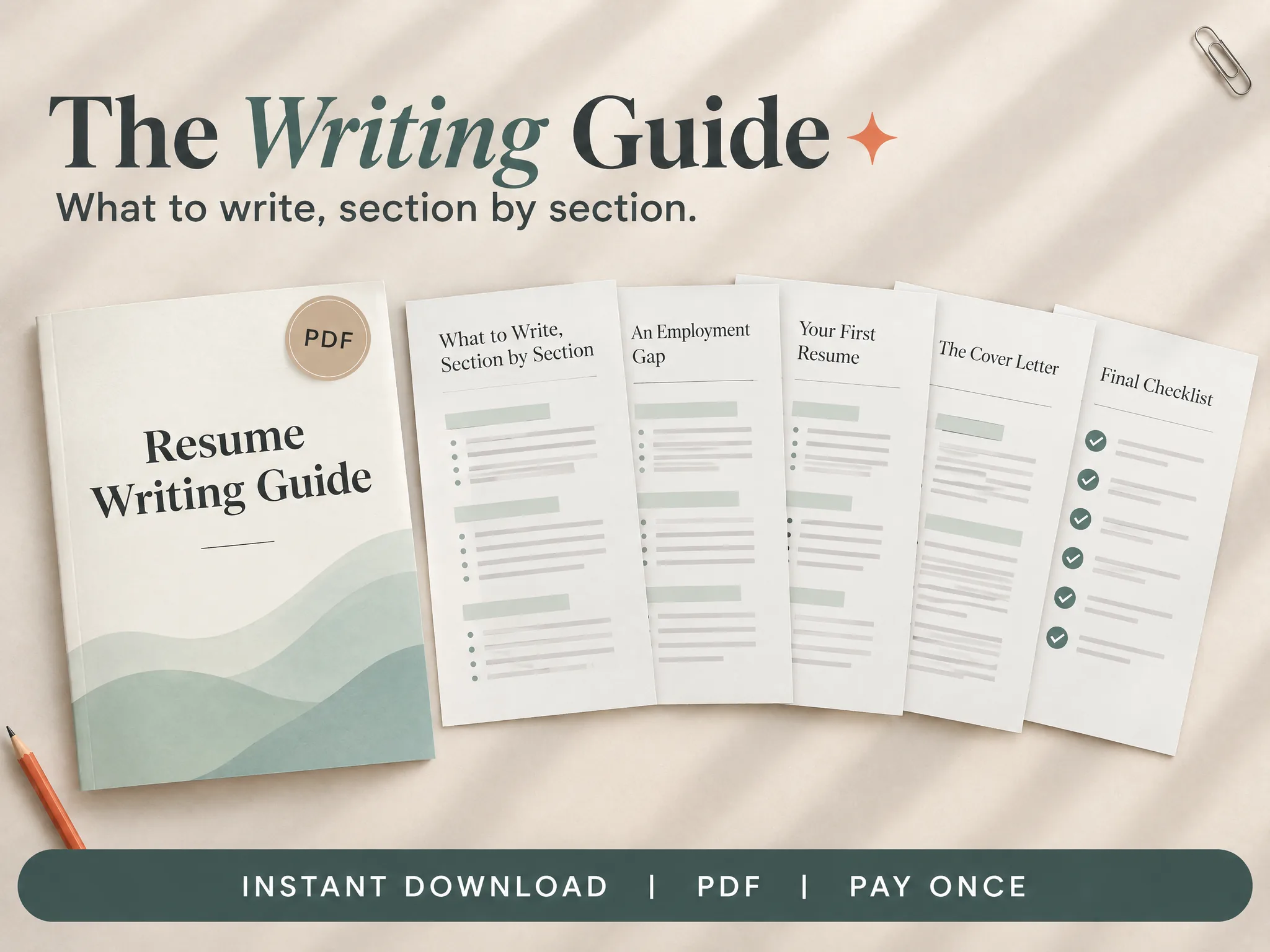
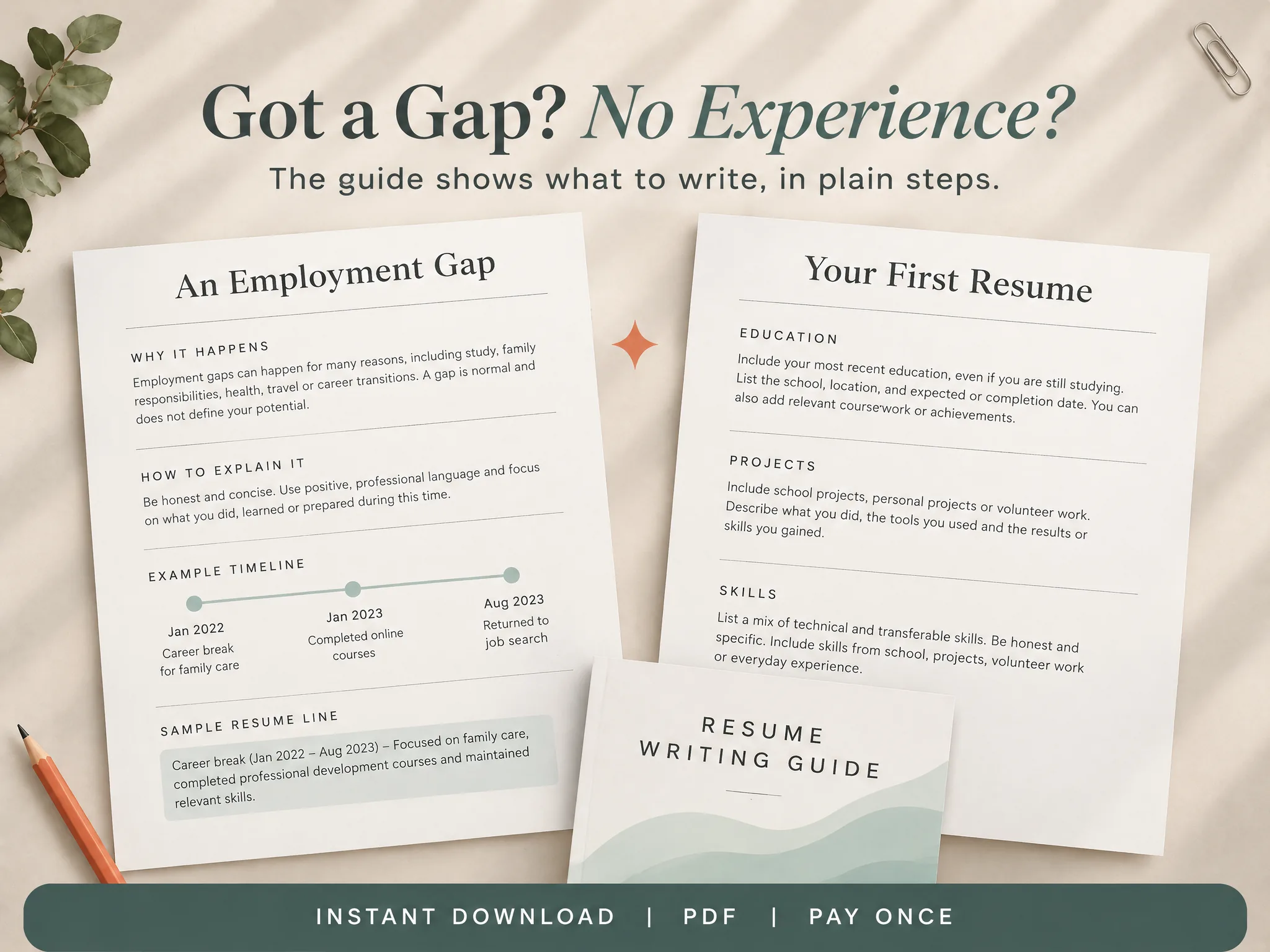
If you are rebuilding a resume after time away, the Ultimate Resume Kit includes a PDF writing guide with sections on employment gaps and first resumes. The guide's gap section covers why breaks happen, how to explain one and an example timeline. Its one-column resume templates come in one-page and two-page versions, with Word, Google Docs and Pages formats.
You still choose which details to share and check that every date is correct. The kit does not decide how an employer will respond to a gap. It gives you a starting structure for writing the resume and a matching cover-letter template if you want to add a short explanation there. See the kit and its included files to decide whether that format suits your application.
Sources and limits
CareerOneStop, sponsored by the U.S. Department of Labor, says the reason for an employment gap does not have to appear on the resume and can be addressed in a cover letter or interview. The UT Austin career center provides examples of optional gap entries with titles, dates and bullets. Harvard Business Review recommends preparing to explain job transitions in an interview. We checked these sources on 22 October 2026.
Their examples are guidance, not a rule for every employer. A job application may request a complete history or a specific date format. Follow those instructions, keep dates accurate and share only the personal details the question requires.
Frequently asked questions
How should I explain a 2-year gap in my resume?
Use the real dates for your jobs. If the gap needs context, add a short, neutral entry such as 'Career break for family caregiving' with the dates, or explain it briefly in a cover letter or interview. You do not need to disclose private medical details on a resume.
What is the best answer for a career gap?
Give a truthful, concise reason, then turn to your readiness for the role. For example: 'I took time away to care for a family member. I am now ready to return and interested in this role because…' Adapt it to what actually happened.
Should I put a career break on my resume?
It depends on the gap and the jobs you are applying for. A short gap may need no separate entry. For a longer break, a brief label can make the timeline easier to follow. Keep the employment dates accurate either way.
Do I have to explain a gap on my resume?
No. You can leave the gap unlabeled and discuss it in a cover letter or interview if it comes up. A resume should show truthful dates and relevant experience; it does not need to include private details about health or family circumstances.
How do I explain a gap caused by being laid off?
State that the role ended in a layoff or restructuring, if you want to clarify it. Then focus on the work you did before the role ended and the position you want next. Avoid blaming language or implying that the layoff was performance-related if it was not.
Can I use only years to hide a resume gap?
Use month and year when that is what the employer asks for or when it gives a clear timeline. CareerOneStop says year-only dates may be an option for gaps under a year, while noting some systems request months or days. Do not change dates to make a gap look shorter.
How can I explain a health-related career break without sharing details?
You can say 'career break for health reasons' or simply 'career break' and keep medical information private. If an accommodation or other formal process is involved, handle those details through the employer's appropriate channel rather than adding them to a resume.